Privacy & Coinjoin
Coinjoin implementations, payjoin tools, coin-control and label software, Tor-friendly wallets, and on-chain privacy analysis tooling.

Ashigaru Wallet
An open-source, self-custodial Android Bitcoin wallet built for privacy by design. It supports Zerolink Whirlpool coinjoins, BIP47 PayNym reusable payment codes, connection to your own Dojo node over Tor, coin control with labelling and freezing, batch spending and a decoy stealth mode. Released under GPLv3.

RoninDojo
Open-source node software built around Samourai Wallet's Dojo backend, providing a full node with Tor enabled by default, a management interface called RoninUI and transaction analysis tools. RoninDojo does not sell hardware; it runs on hardware you supply such as a Raspberry Pi 5, Rock5b+ or an x86 machine.

Wasabi Wallet
An open-source, non-custodial desktop Bitcoin wallet for Windows, Linux and macOS built around trustless multi-party transactions routed over Tor. It implements the WabiSabi coinjoin protocol along with coin control and labelling.
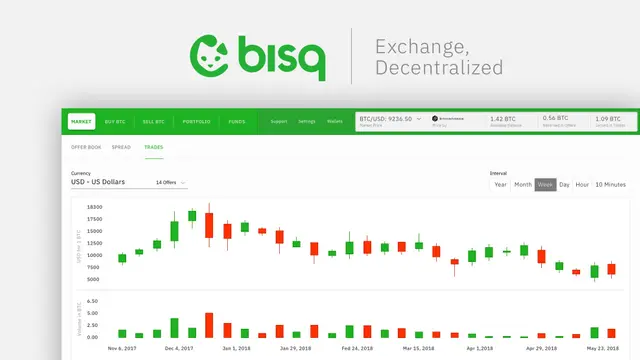
Bisq
An open-source desktop application forming a decentralised Bitcoin exchange network. Trades are peer-to-peer with funds held in 2-of-2 multisig rather than by an exchange, and the application routes over Tor with no account signup.
Elements
The open-source blockchain platform that Liquid is built on, extending Bitcoin with Confidential Transactions, issued assets and federated block signing. It can be run as a sidechain node or as a standalone chain.

JoinMarket
A Bitcoin coinjoin implementation with a market structure: makers offer their coins for mixing and earn a fee, takers pay to join. It runs against your own Bitcoin Core node and is maintained as an open-source client-server project.

Liquid Network
A Bitcoin sidechain operated by a federation, offering Confidential Transactions that hide amounts and asset types from third parties, plus faster settlement and asset issuance. Liquid Bitcoin is held in a two-way peg with Bitcoin.
Mercury Layer
A statechain implementation that uses a blind co-signing server so Bitcoin UTXO ownership can be transferred instantly and off-chain while remaining fully self-custodial. Because the signatures are blinded, the server cannot learn addresses, amounts or transaction contents.

Payjoin
The project home for payjoin (BIP78 and the newer async payjoin flows), a way to pay someone in a transaction to which they also contribute an input. It breaks the common-input-ownership assumption used by chain surveillance while also saving fees.
RoboSats
A peer-to-peer Bitcoin exchange that operates over Tor using Lightning hold invoices as escrow, with pseudonymous robot identities instead of accounts. The client is open source and the documentation site explains the trade flow.

Tor Project
The nonprofit behind the Tor anonymity network and Tor Browser. Most self-custody node software and privacy-focused Bitcoin wallets route their traffic over Tor so that a wallet's queries and broadcasts are not tied to a home IP address.
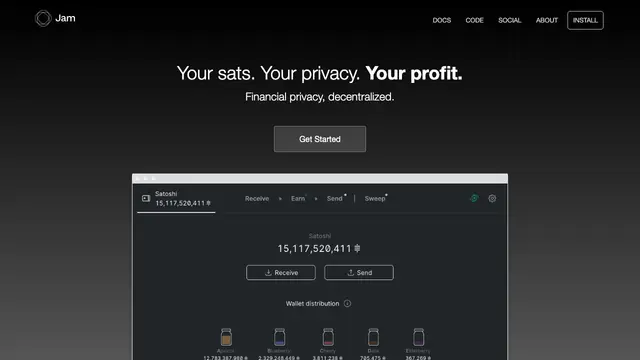
Jam
A web interface for JoinMarket that makes running a maker or taker considerably easier than the command line. It is designed to be installed on a home node alongside JoinMarket.

Vexl
A mobile app for trading Bitcoin peer-to-peer within your real-world contact network, designed so offers stay inside your social graph rather than on a public order book.

electrs
An efficient reimplementation of the Electrum server in Rust. Running it beside Bitcoin Core lets Electrum-protocol wallets such as Sparrow and Electrum query your own node instead of a public server.
Electrum Personal Server
A minimal Electrum server designed for a single user. Instead of indexing the whole chain it watches only your own addresses through Bitcoin Core, so an Electrum wallet can connect privately to your node on modest hardware.
OpenSwap (Coinswap)
A working implementation of the Maxwell–Belcher coinswap protocol, which swaps coins between peers through off-chain contract transactions so the swap does not appear as a coinjoin-shaped pattern on chain. Published as binaries and libraries by the Citadel FOSS project.

Silent Payments
A reference site for BIP352 silent payments, a scheme that lets someone publish a single reusable static address while each payment still lands on a unique, unlinkable on-chain output. The site tracks which wallets support it.
BlindBit Oracle
A Go implementation of a BIP352 silent payments indexing server. Running one lets a silent-payments wallet scan for its own payments against your own infrastructure instead of a third-party service.
Neutrino
Lightning Labs' privacy-preserving Bitcoin light client, implementing compact block filters (BIP157/158) so mobile and lightweight wallets can sync without revealing which addresses they care about.
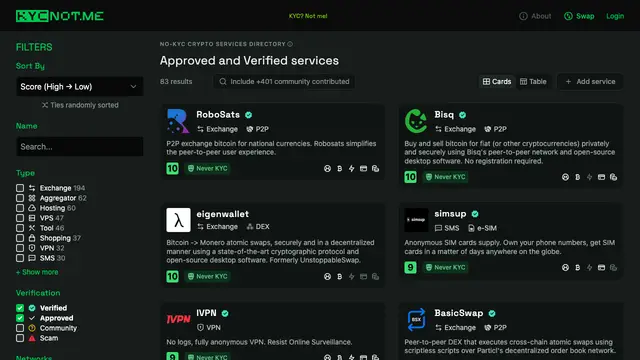
KYCnot.me
A directory that reviews and scores Bitcoin and crypto services — exchanges, wallets, VPNs and more — by how much identity verification they require, with a privacy score attached to each listing.

LNProxy
A simple Lightning privacy tool that wraps a Lightning invoice so the payer does not learn the receiving node's identity, giving receivers a measure of privacy when sharing invoices publicly.

Peach Bitcoin
A non-custodial mobile marketplace for buying and selling Bitcoin peer-to-peer without KYC, available on iOS, Android and as a direct APK download.
Payjoin Dev Kit (rust-payjoin)
The reference Rust implementation of payjoin, packaged as libraries so wallets and payment processors can add sender and receiver support without writing the protocol from scratch.

Hodl Hodl
A non-custodial peer-to-peer Bitcoin trading platform. Trades settle through multisig escrow contracts, so the platform states it never holds user funds.
Questions
Frequently asked questions
What counts as privacy & coinjoin?
Coinjoin implementations, payjoin tools, coin-control and label software, Tor-friendly wallets, and on-chain privacy analysis tooling.
What are privacy & coinjoin?
Coinjoin implementations, payjoin tools, coin-control and label software, Tor-friendly wallets, and on-chain privacy analysis tooling.
Open source or closed?
Open-source firmware and software can be audited by anyone. Many experienced users prefer it. Listings note what the maker publishes.